Tree Health Assessment & Inspection in Riverview, FL
Down South Removal Tree & Land Clearing Riverview provides tree health assessment and inspection for residential and commercial properties across Hillsborough County. When a tree is showing signs of decline, damage, or structural concern, an inspection helps you understand what is going on and what to do about it.
Property owners request tree health assessments for many reasons — a thinning canopy, dead limbs, trunk damage, unusual lean, storm impact, root-zone disturbance, or uncertainty about whether a tree needs pruning or removal. An inspection looks at the whole tree in context before making a recommendation.
Observable Concerns
Signs That May Warrant a Closer Look at a Tree
Trees do not always announce their problems clearly. These are the observable signs that property owners in Riverview notice before requesting an inspection.
Dead Branches
Limbs in the canopy that have died and are no longer producing foliage.
Canopy Thinning
A reduction in foliage density that may indicate the tree is stressed or declining.
Trunk Injuries
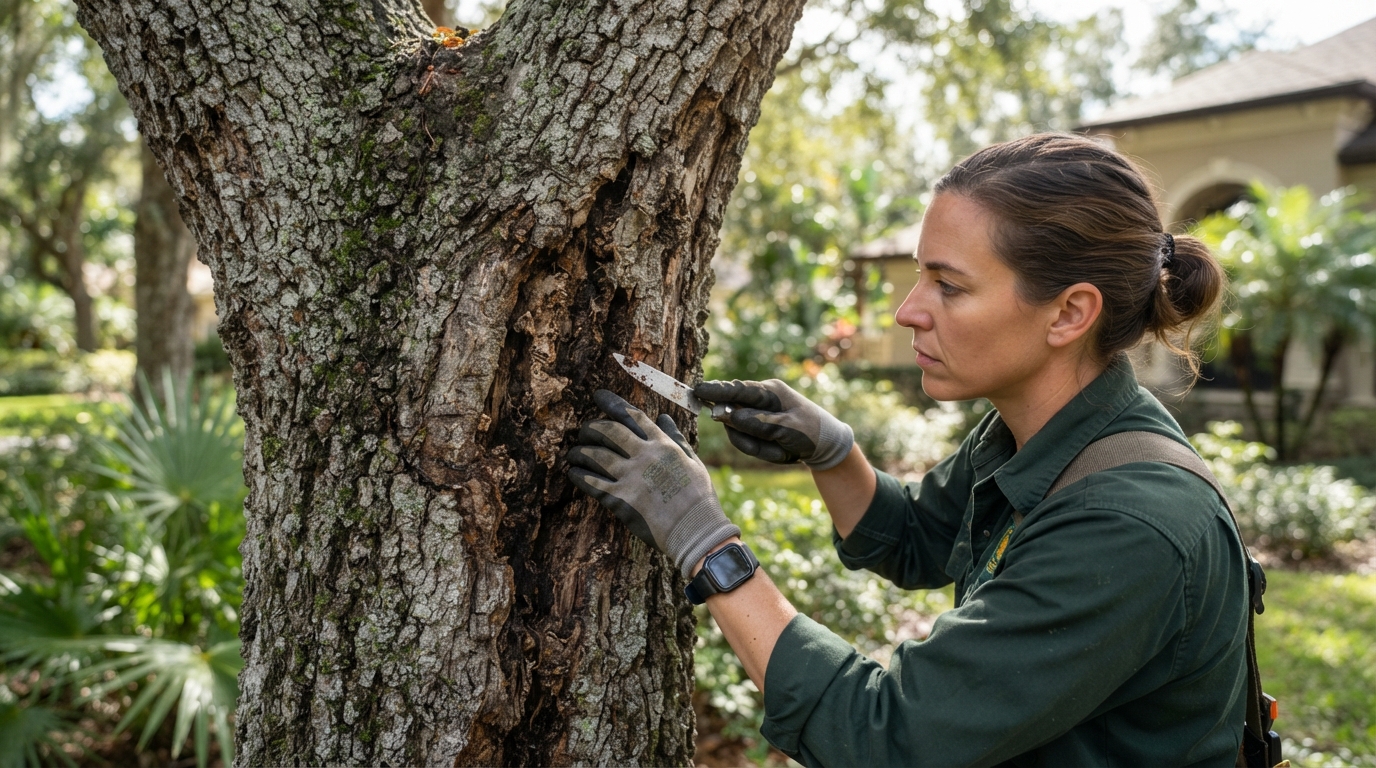
Cavities, bark loss, cracks, or damage to the main trunk that may affect structure.
Unusual Lean
A lean that is new or worsening, particularly after storms or root disturbance.
Dead branches are one of the most visible signs. A limb that has lost its foliage or has bark peeling away is dead and may need removal — but the question is why it died. If it is an isolated limb, the rest of the tree may be fine. If multiple branches are dying, the tree may be in decline.
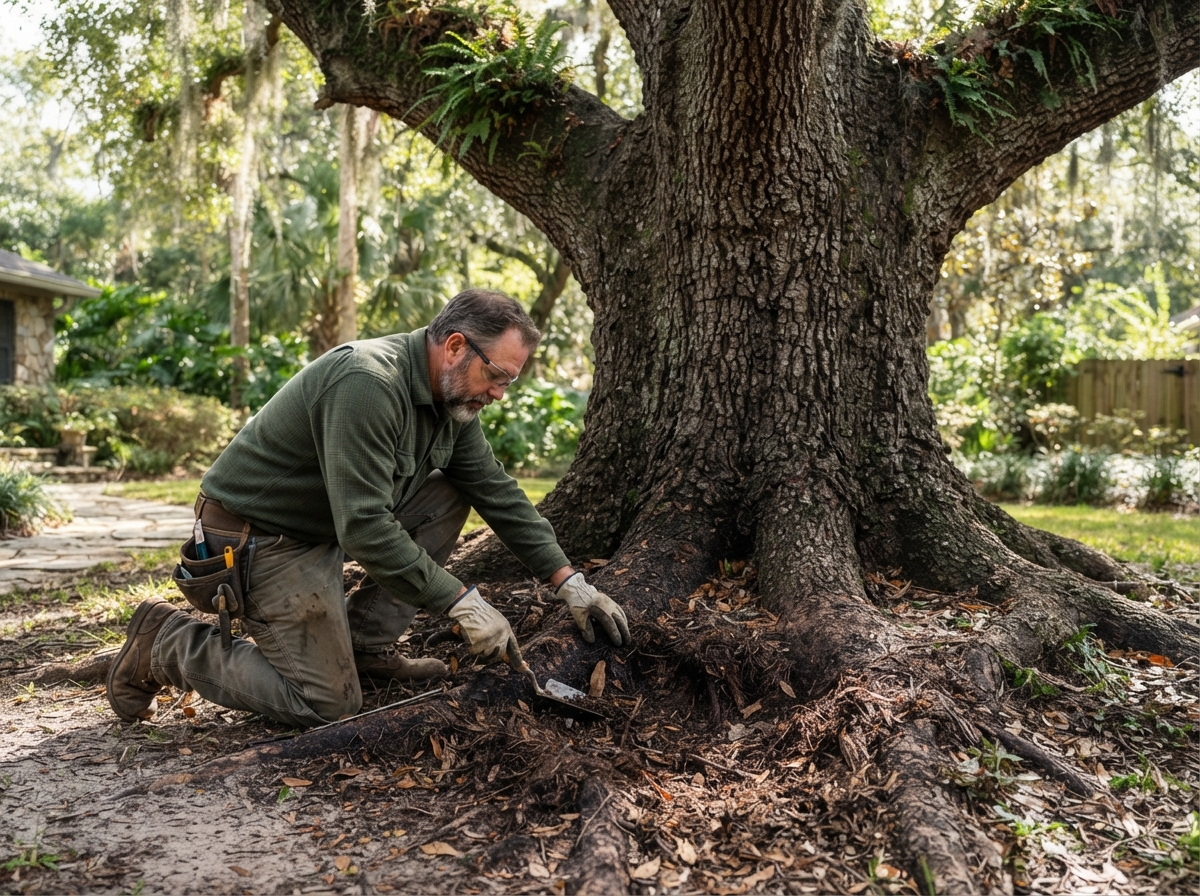
Canopy thinning — a reduction in the density of leaves and small branches — can indicate stress. Visible cavities or trunk injuries may or may not affect structural integrity depending on their location and depth. An unusual lean, especially one that developed recently, can indicate root instability. Root-zone disturbance from construction, trenching, or grade changes can affect a tree even when the canopy looks healthy.
The key point is that individual symptoms do not automatically mean the tree must be removed. A tree with dead limbs may need pruning. A leaning tree may be stable. An inspection looks at the full picture — the tree, the site, and what is around it — before making a recommendation.
Residential & Commercial
Tree Inspections for Riverview Homes & Commercial Properties
Where a tree is located matters as much as its condition. A healthy tree over a roof and a healthy tree over an open field carry very different levels of risk.
For Riverview homes, tree inspections often focus on trees near the structures that surround them — roofs, driveways, fences, pool cages, and screen enclosures. A tree that is showing signs of decline is a higher priority when it is over a house than when it is over an open yard. The inspection considers both the tree's condition and the potential targets beneath it.
For commercial properties, inspections address trees near parking areas, sidewalks, buildings, and signage — places where a falling limb or tree could affect people or property. HOAs and property managers use inspections to identify which trees in a common area need attention and which can be left alone or monitored.
Construction zones add another layer. Trees near planned building, trenching, or grade changes can be affected by the work, and an inspection before construction starts helps identify which trees to protect, which to prune, and which may need removal as part of the project.
After the Inspection
What May Happen After a Tree Assessment
An inspection is not a one-way path to removal. It can lead to several different recommendations depending on what the tree needs — and what the property needs.
A balanced assessment considers the full range of outcomes. If the tree is stable and the concern is minor, the recommendation may be no immediate work — just continued observation. If specific branches are the issue, targeted pruning or damaged limb removal may be the answer. For structurally weak but valuable trees, cabling and bracing can reduce the risk of failure.
If the tree is dead, hazardous, or cannot be maintained safely, removal may be the recommendation. Root-related concerns may lead to root pruning or barrier installation. And in some cases, the situation may warrant further specialized evaluation before a final decision is made.
Related: tree trimming & pruning, tree cabling & bracing, dead & hazardous tree removal, root pruning & root barrier installation, and certified arborist reports & tree risk assessments.
No Immediate Work
The tree is stable and the concern does not require action right now.
Monitoring
The tree is watched over time to see if the condition changes.
Targeted Pruning
Specific branches are removed to address dead wood or clearance.
Damaged Limb Removal
Broken or compromised limbs are taken off while the tree remains.
Cabling & Bracing
Structural reinforcement for weak but valuable trees to reduce failure risk.
Removal Consideration
If the tree is dead, hazardous, or unstable, removal may be recommended.
Root Management
Root pruning or barrier installation where root-zone issues are present.
Further Evaluation
Additional specialized assessment if the situation warrants it.
FAQs
Tree Health Assessment FAQs in Riverview
Direct answers about tree inspections, what they include, and how they differ from formal arborist reports.
Request a Tree Health Assessment in Riverview
Tell us about the tree and what you are seeing. Down South Removal provides tree health assessments and inspections for residential and commercial properties across Riverview and Hillsborough County.